EU pay transparency, made manageable
Pay transparency.
From the directive to the evidence.
Software for employers, HR and compliance
Analyse pay structures, assess work of equal value, detect pay gaps, meet reporting duties and document measures – in one central platform.
Dir. (EU) 2023/970
Platform modules
- Pay Gap AnalyticsArt. 9, 10 · Median · 5% threshold
- ReportingArt. 9 · reporting year 2026
- RemediationArt. 10 · Factors · budget · adjustment
- Employee RequestsArt. 7 · reply within 2 months
- Hiring ComplianceArt. 5 · pay range for candidates
Real app screenshots
How legal requirements become concrete app functions.
The screenshots show a demo tenant. For Austria until final national transposition, the EU Directive, existing Austrian Equal Treatment Act rules and later Austrian implementation must be assessed separately.
Requirement
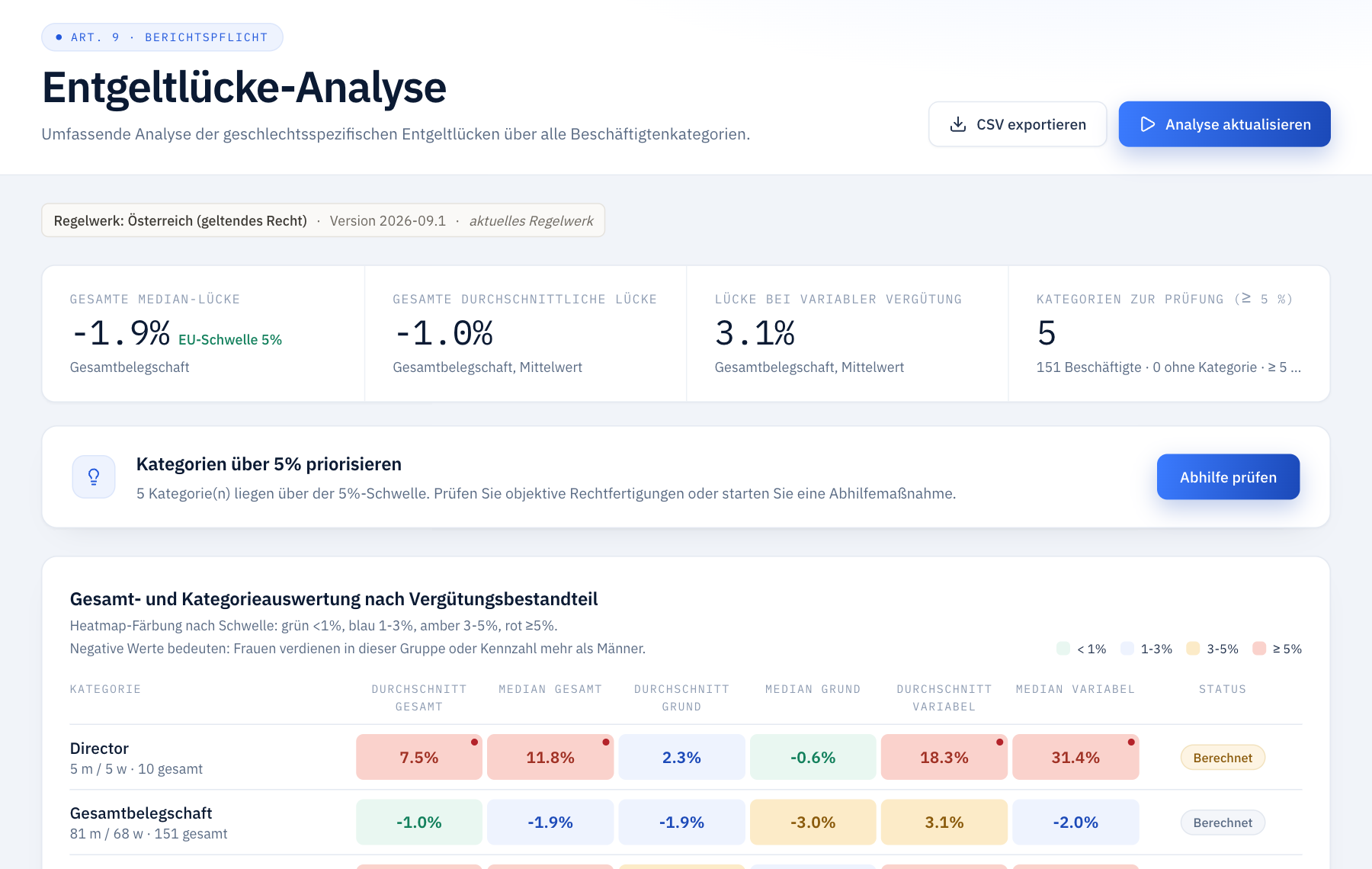
Article 9 requires figures on the pay gap – overall, as a median, for variable components and per worker category.
Fulfillment in the app
The analysis shows the median and mean gap, variable pay and a heatmap per category; categories above 5% are highlighted.
Requirement
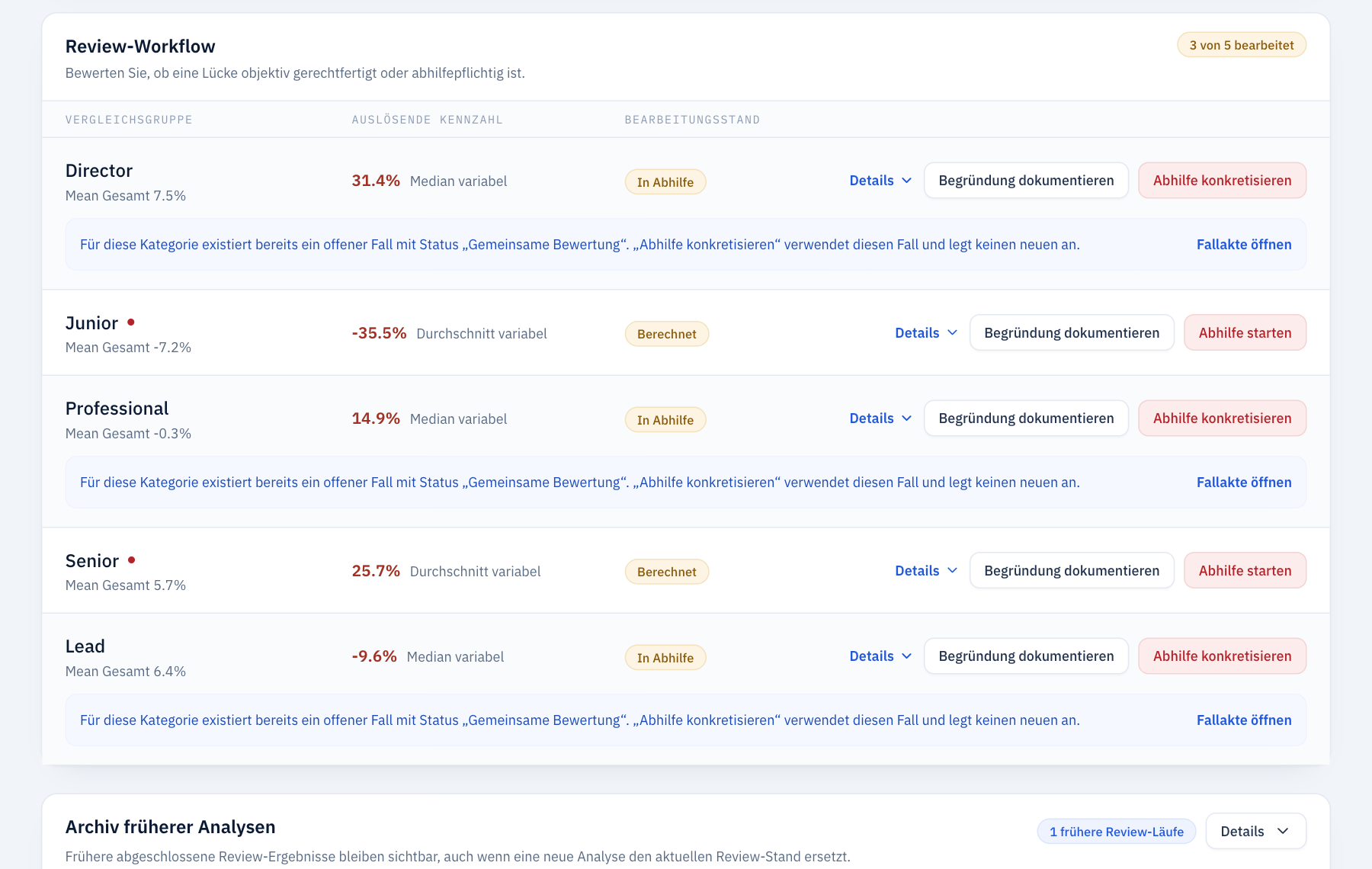
Article 10 requires a joint pay assessment for gaps of 5% or more that are not objectively justified.
Fulfillment in the app
For each conspicuous comparison group you decide: document a justification or start remediation. Existing cases are linked instead of duplicated.
Requirement
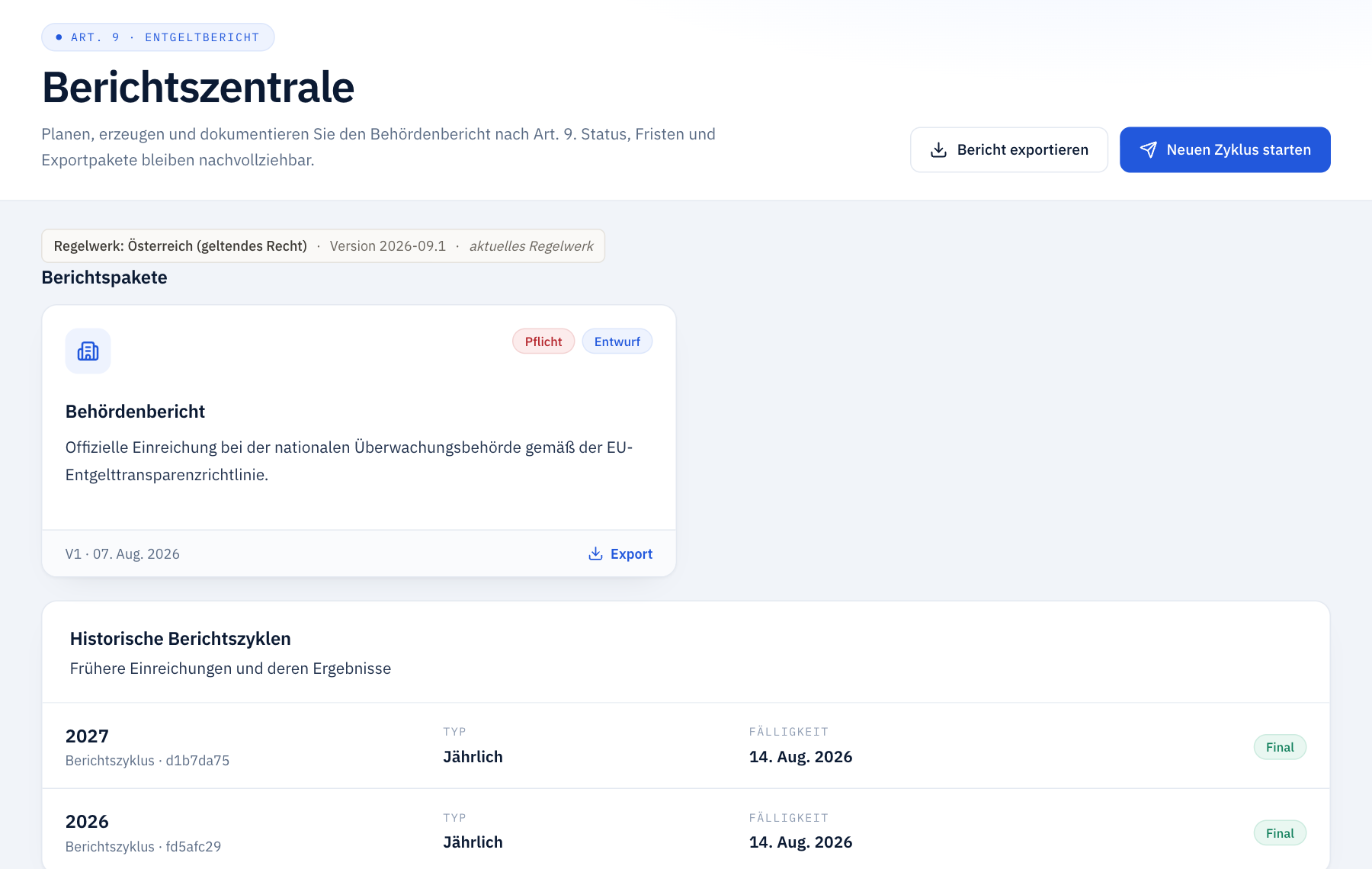
Article 9 requires regular reporting to the competent body – complete and traceable.
Fulfillment in the app
The reporting center bundles report packages such as the authority report, the export and past reporting cycles with due date and status.
Requirement
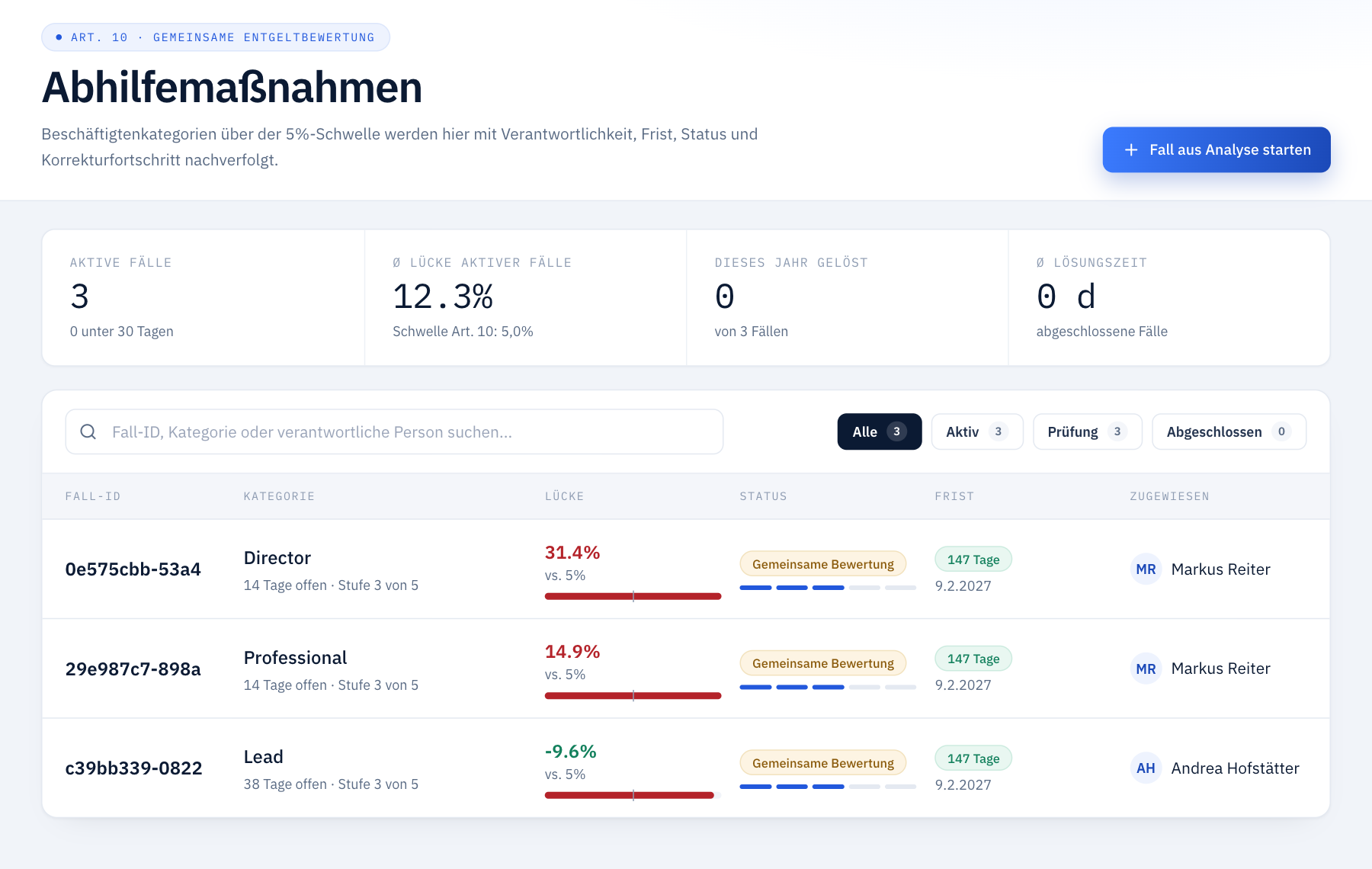
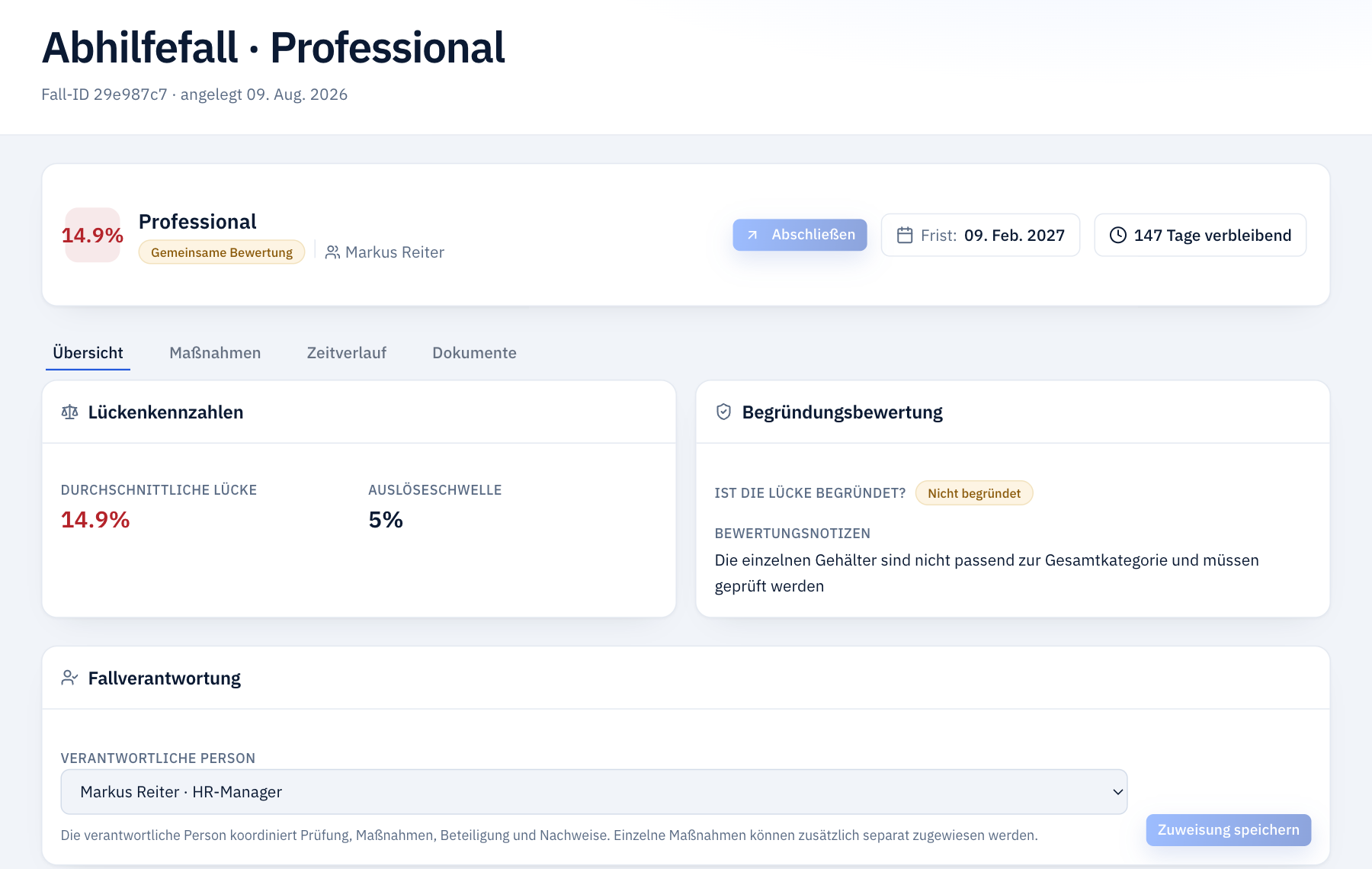
Article 10 requires unjustified pay differences to be remedied in cooperation with worker representatives.
Fulfillment in the app
The case overview shows active cases, the gap per category, the status of the joint assessment, the deadline and the responsible person.
Requirement
The joint pay assessment includes, among other things, the reasons for the differences and measures to address them.
Fulfillment in the app
Each case file records the gap, the justification assessment, deadline and ownership; measures, timeline and documents have their own tabs.
Requirement
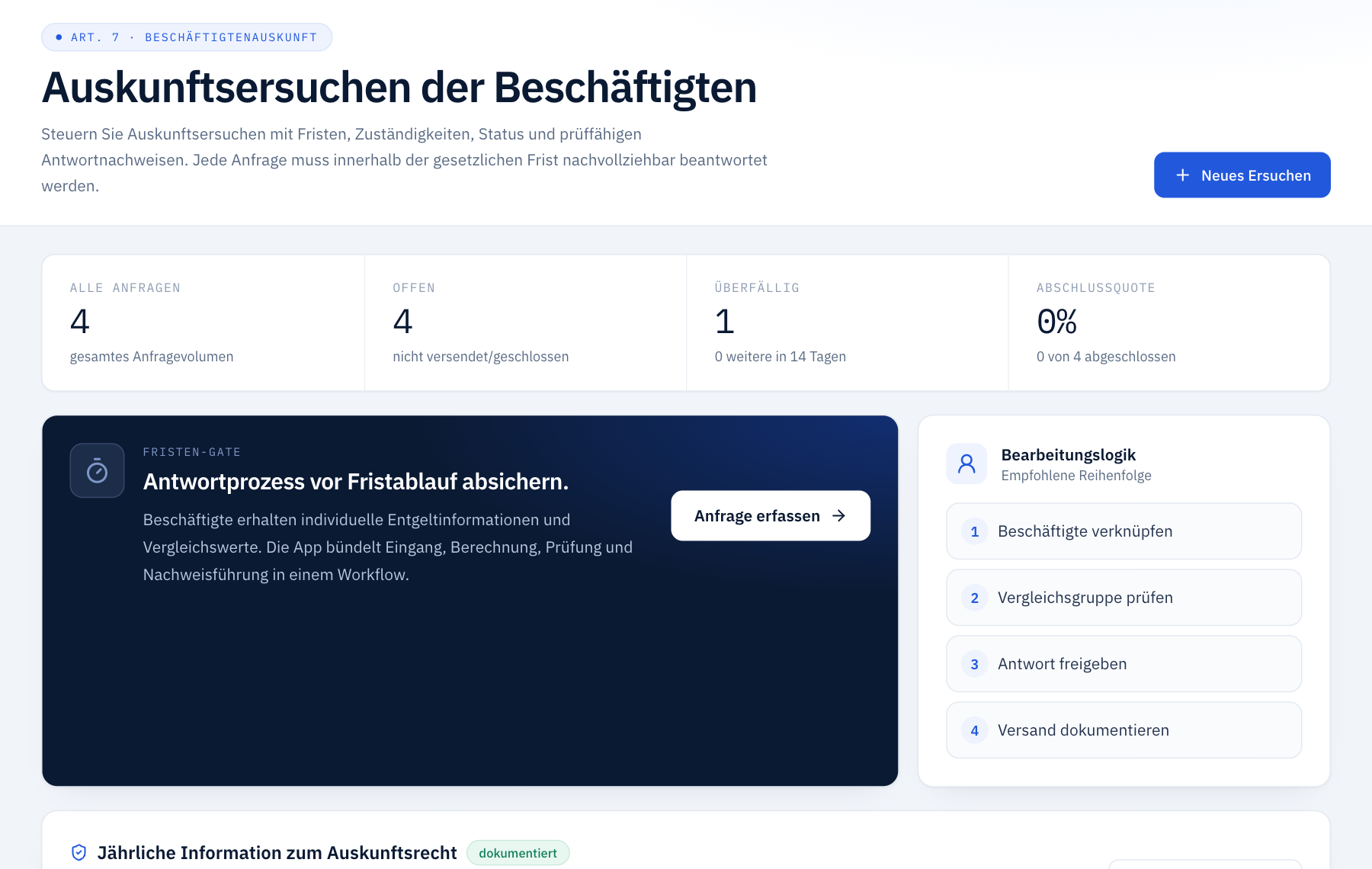
Workers have a right to information on their own pay and comparison values; responses must be given within two months and traceably.
Fulfillment in the app
The app shows open and overdue requests and guides through four steps: link the worker, check the comparison group, approve the response, document dispatch.
Requirement
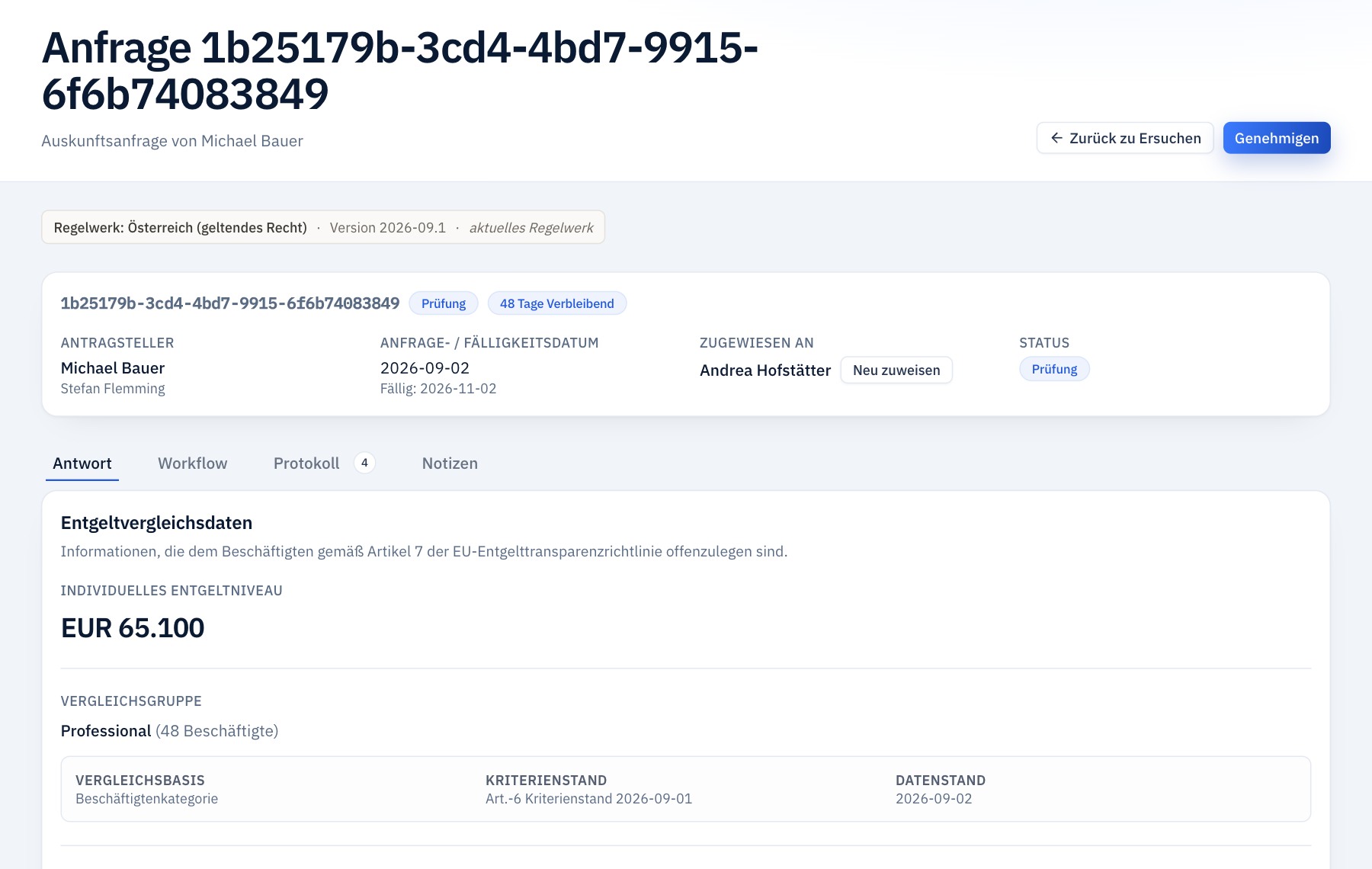
On request, employers must provide in writing the individual pay level and the average pay levels of the comparison group broken down by sex.
Fulfillment in the app
The request file shows deadline, assignee and status and prepares the individual pay level and comparison group with criteria and data status for the response; workflow, audit log and notes have their own tabs.
Requirement
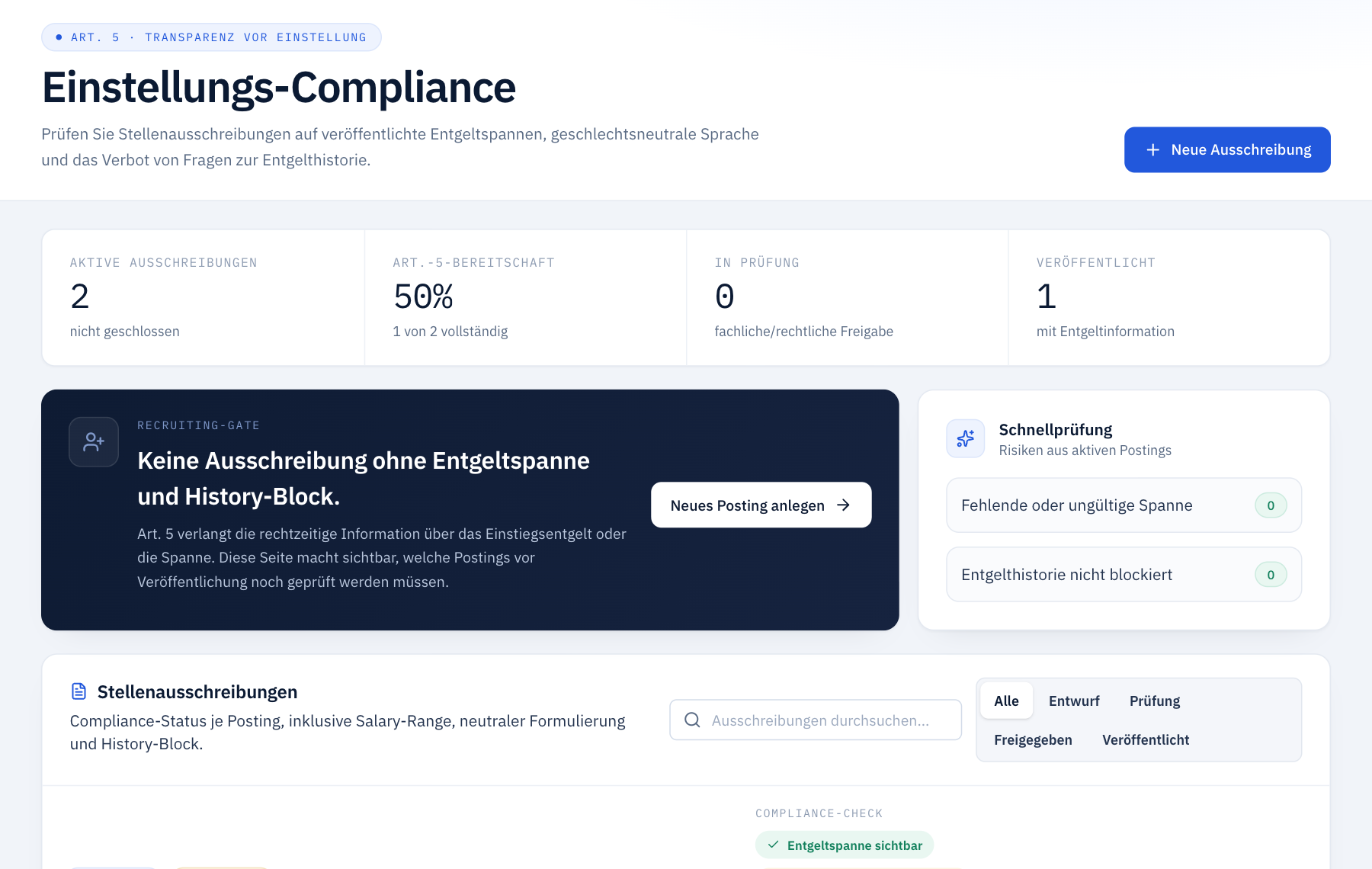
Article 5 requires timely information on starting pay or the pay range and prohibits questions about pay history.
Fulfillment in the app
Every job posting is checked before publication for a pay range, gender-neutral wording and the ban on pay history questions.
Requirement
Implementation involves HR, compliance, legal, management and worker representatives – all need the same understanding of the duties.
Fulfillment in the app
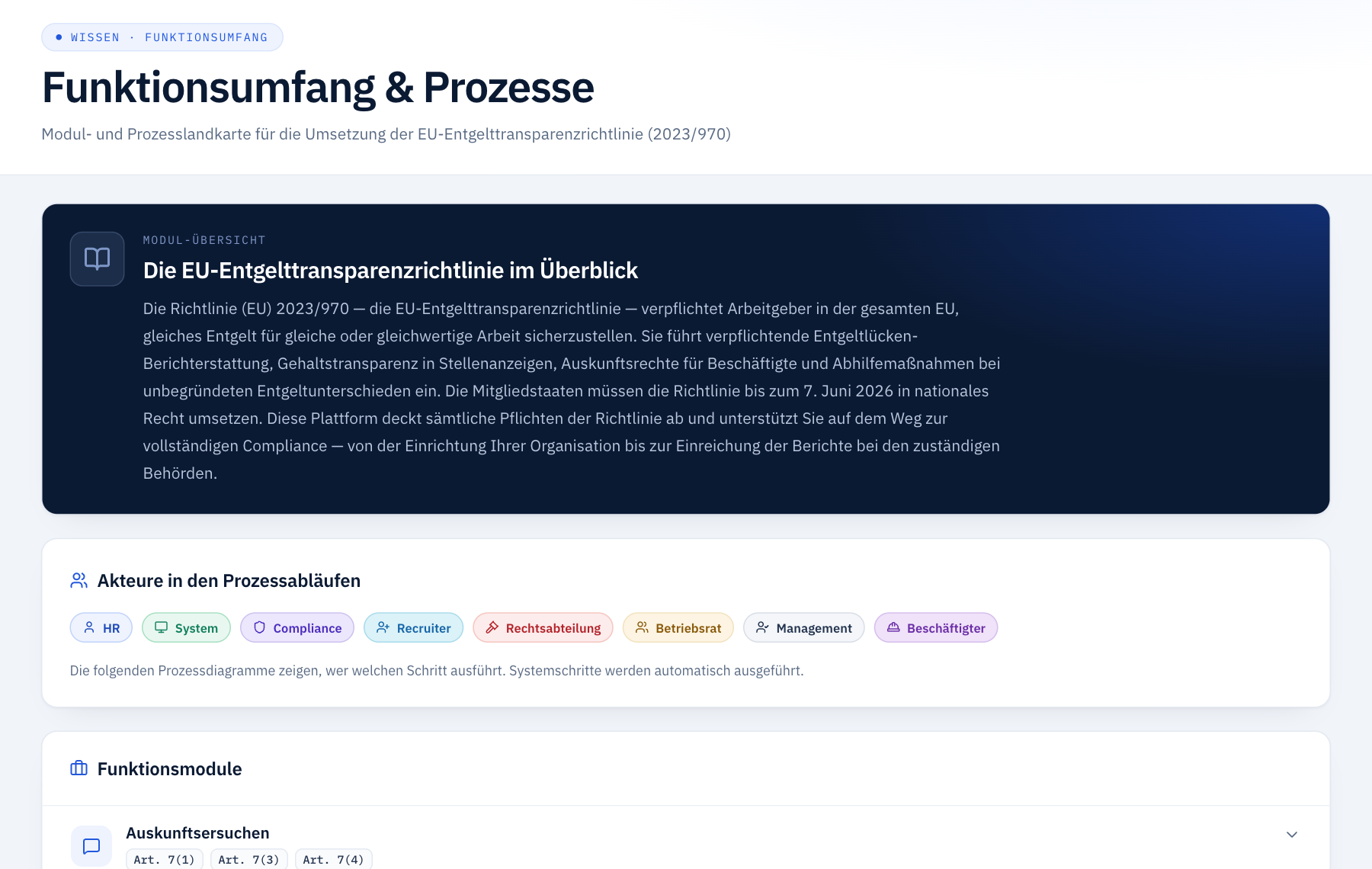
In the knowledge area, the app explains the Directive, shows which role handles which process step and maps the articles to the feature modules.
National transposition
The deadline has passed. National laws are on their way.
The EU Pay Transparency Directive requires all Member States to transpose its rules into national law by 7 June 2026. The first countries have done so; Austria and Germany are still working on their laws. For employers, this is no breathing space: those who prepare now will meet the obligations from day one.
All deadlines at a glance →As of 15 September 2026. Sources: Directive (EU) 2023/970, German Bundestag notices, ORF reporting and national official journals. Drafts not yet adopted may change. Not legal advice.
Under the Directive, employers with 150 or more workers report for the first time by 7 June 2027 – on calendar year 2026. Pay criteria, job evaluation and reliable data take time to prepare.
The data is being generated nowCountries at a glance
- AustriaDraft under coordination
On 6 June 2026, the labour ministry submitted a draft bill for coordination within the government; a government bill has not yet been tabled. According to media reports, it provides for income reports from 100 workers and administrative fines of up to EUR 60,000 for repeated breaches.
Sources: ORF, 7 June 2026 · ORF, 6 August 2026
- GermanyDraft bill pending
According to the federal government, preparatory work was completed in July 2026, but no draft bill has been published yet. Media reports point to a law in 2027. Until then, the 2017 Pay Transparency Act applies.
Sources: Bundestag, 16 July 2026 · Bundestag, 9 September 2026 · taz, 1 June 2026 · EntgTranspG
- Other EU countriesFirst laws in force
Italy, Slovakia and Malta, among others, transposed on time; Greece followed in July 2026. Parliaments in the Netherlands and Finland are debating bills. The European Commission rejects postponing the deadline.
Sources: Slovakia · Italy · Malta · Greece · Netherlands · Finland · European Commission
Consequences of breaches
- Art. 23Penalties and fines
Member States must lay down effective, proportionate and dissuasive penalties, including fines – also for repeated breaches.
- Art. 16Compensation without a cap
Affected workers receive full compensation, including back pay, related bonuses and interest on arrears.
- Art. 18Burden of proof on the employer
Employers that breach transparency duties must prove in proceedings that there was no pay discrimination.
Packages
Three packages. One goal: verifiable implementation.
Packages follow data volume, organizational complexity and desired governance. In the demo, we clarify which scope makes sense for your preparation.
Basis
Prepare pay transparency in a structured way.
Up to 49 workers
For smaller employers that want to structure jobs, criteria and information-request preparation cleanly.
EUR 2,490/ year
EUR 249 / month
- Job architecture & evaluation
- Hiring compliance
- Pay criteria
- Information-request preparation
- Compensation data & HR import
- Change log
Professional
RecommendedImplement the directive operationally.
Up to 249 workers
For employers that want to combine pay analysis, reporting preparation and measure management.
EUR 4,490/ year
EUR 449 / month
- Everything in Basis
- Worker categories
- Gender pay gap analysis
- Reports, finalization & export
- Measure management
- Works council access
Enterprise
Pay transparency for complex organisations.
Unlimited workers
For complex organizations with multiple legal entities, central sign-in and custom integrations.
Custom offer
Monthly price on request
- Everything in Professional
- Multiple legal entities
- Country rulebook
- SSO login
- Integration on request
Directive information
What does the EU Pay Transparency Directive require?
The answers follow the EU baseline. National transposition laws in Germany and Austria may add details, procedures and deadlines.
What does the EU Pay Transparency Directive require?
The Directive strengthens the principle of equal pay for equal or equivalent work. It focuses on transparency before and during employment, information rights, reporting duties and stronger enforcement mechanisms.
When does the Directive apply?
The Directive is in force; Member States must transpose it into national law by 7 June 2026. The first reporting dates are staggered by employer size under the EU baseline. National transposition laws may add details.
Which companies are affected?
Certain transparency and information-right topics affect employers regardless of size. Regular reporting duties begin under the EU minimum standard from 100 workers, with different deadlines for 100-149, 150-249 and 250+ workers.
What data do employers need?
Practically relevant data includes job and role information, criteria for equal or equivalent work, base pay, variable components, working time/FTE, worker categories and documented justifications for objective differences.
What does equal or equivalent work mean?
Comparability is not based only on identical job titles. It depends on traceable criteria such as requirements, skills, responsibility, strain and working conditions, plus other job-related factors.
What happens when pay gaps appear?
The Directive requires conspicuous pay differences to be analyzed and either explained with objective, gender-neutral criteria or addressed through measures. The concrete national implementation must be considered.
How does software support implementation?
Software does not replace legal advice, but it supports structured implementation: consolidating data, evaluating jobs, analyzing pay gaps, preparing information responses and reports, and documenting decisions traceably.
Ready for transparent pay?
See how your company can implement pay transparency requirements in a structured way and document them continuously.
Contact
Questions about implementation? Write to us.
Whether it is a demo, choosing a package or preparing your data – we get back to you personally and clarify how Entgelt-Transparenz.at fits your company.
- Phone
- +43 1 928 444 21
We usually reply within one business day.